1. Not just an app shell
DartsStar is not only a match screen with login in front of it. League play, training, tasks, cup, ranked, equipment and statistics all feed into one ongoing career.
Public academy
This page explains DartsStar more concretely than a short homepage pitch: which choices matter early, how training really works, why league, cup and ranked serve different roles, and why the game is built around daily and weekly return moments. The goal is not a thin promotional summary, but a credible public explanation of how the career loop actually feels.
DartsStar is not only a match screen with login in front of it. League play, training, tasks, cup, ranked, equipment and statistics all feed into one ongoing career.
Form, energy, fatigue, opponent strength and competition context make progress feel earned rather than completely linear. That friction is where the strategy lives.
This academy page complements the broader guide with priorities, recurring player questions and a clearer explanation of why the systems fit together.
New players should not read DartsStar as a collection of isolated features. A better public explanation is to think in order: build a readable baseline first, use the return moments well, and only then widen your optimization.
Early on, understandable training focus is more useful than spreading every session across every attribute. A readable base makes match outcomes and progression easier to understand.
League fixtures give the career its rhythm. Training, task planning and form evaluation all feel more meaningful because they point toward a repeated competition cycle.
Daily tasks, weekly goals and planned sessions are not filler. They shape when small optimizations are most worthwhile and keep the career anchored between bigger milestones.
Venue, equipment and other long-term layers make more sense once league form, training and energy management already feel familiar.
The training system is not meant to be a cosmetic bar. Different drills strengthen different parts of the match experience, and their value depends on how you handle energy, daily form and fatigue.
The public takeaway is important here: not every session is equally good, not every day is equally efficient, and that is exactly what separates the system from a thin plus-one loop.
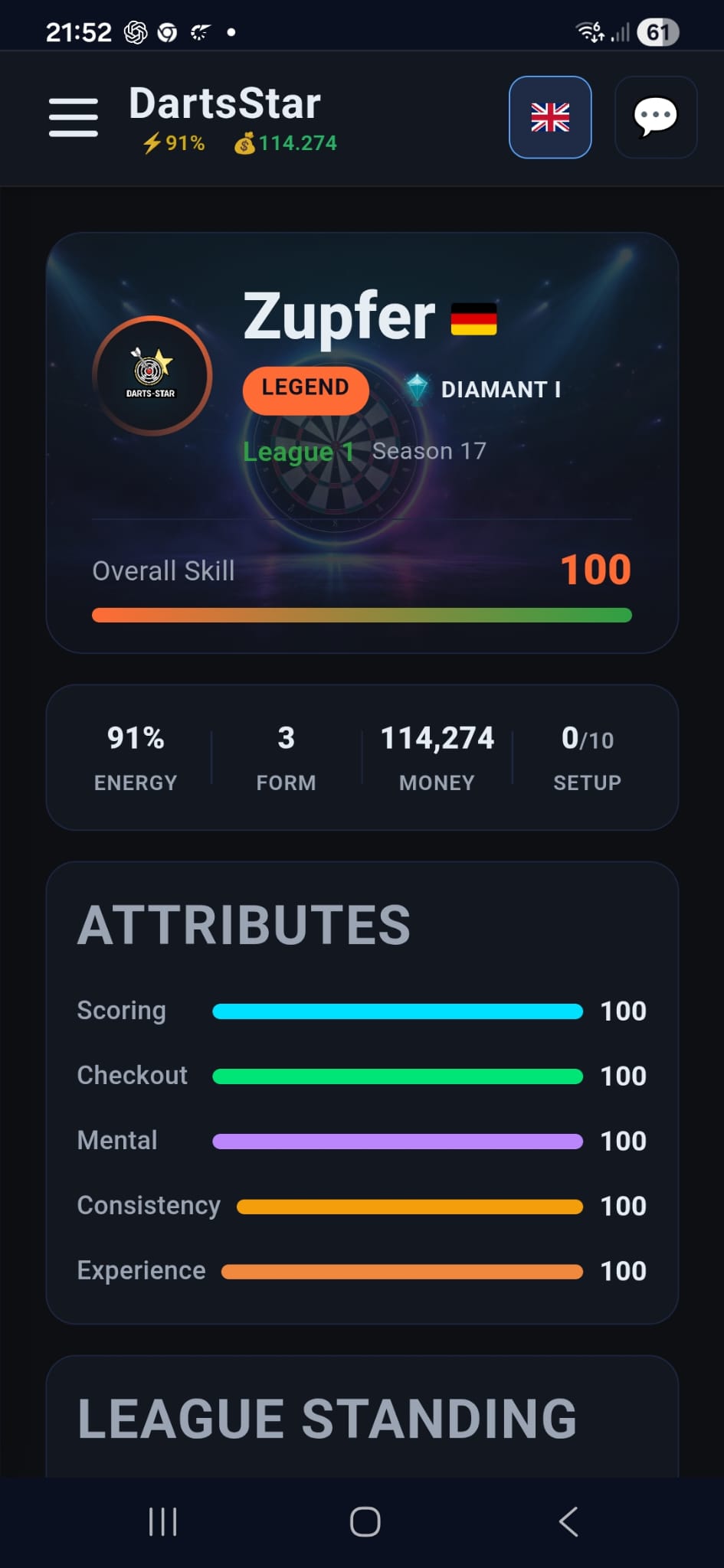
These modes are not just three menu entries with different paint. They produce different kinds of tension and progress.
The league is the longest arc. It is where the core career feeling comes from through standings, season flow, promotion and relegation.
Knockout play creates different stakes from league progression. That changes the emotional rhythm even though the same player systems still matter.
Ranked matters most for visible competition. MMR and placement movement offer a sharper signal than season standings alone.
Daily tasks and weekly goals tie the modes into everyday play. That creates clear reasons to return even between major milestones.
Energy, money and timing windows make the career readable. Without those constraints, every decision would be instantly interchangeable. With them, priorities become visible.
Energy makes training meaningful because every session cannot happen at once. You have to choose what matters most right now.
Rewards, shop decisions and long-term upgrades give wins and task progress a value outside one isolated match result.
These layers add longer-term motivation without replacing the core of league play, training and progression.
Because resources are limited, the time between matchdays feels like management with consequences instead of empty waiting.
This is intentionally simplified, but it shows why DartsStar is more than a narrow landing page with a register button.
No. The academy page exists to explain publicly how the systems interact, so visitors can judge before signing up whether the career structure and rhythm are actually interesting to them.
Ranked is important for direct competition, but it is not the only progression source. League, cup, tasks and training remain the frame in which the career develops over time.
The guide explains the broad overview. The academy goes deeper into priorities, resources and the logic behind the systems. Together they create a much clearer public picture of the product.