Darts manager game and darts simulation: how DartsStar works
DartsStar is a long-term darts manager game in the browser and as an Android app. This public guide is for visitors searching for an online darts manager, a darts simulation game or a darts career simulation. It explains how league play, training, matchdays, cup, ranked and long-term progression fit together – so you can judge before signing up whether the game matches the kind of management experience you want.
League ladder with promotion and relegationTraining with energy, form and fatigueCup, ranked, tasks and statistics
1. A long-term career loop
You are not just opening one match screen. Your decisions affect multiple systems at once: league position, form, attributes, tasks, tournaments and long-term statistics. Every training drill, every matchday, and every resource investment changes how your career unfolds over weeks and months.
2. Real users at the core
Rankings, chat, league context and ranked revolve around real accounts. Matches are simulated on the server so training, form and player growth stay consistent across all players. The league environment and opponent strength are driven by actual player progression, not static bot tables.
3. Built for repeat play
Daily tasks, weekly goals, matchdays and training with energy cost create a rhythm that supports long-term play. Each session gives you meaningful decisions: where to invest limited energy, which competition to prioritise, and how to react to your latest results and form changes.
The core loop in DartsStar
At the center of DartsStar is an ongoing career. You train your player, track how performance changes, move through matchdays and then react to results, form and new goals. That creates a game rhythm where planning and development matter just as much as isolated wins. The loop connects training decisions directly to match outcomes, and match outcomes feed back into your training priorities.
League structure
You begin in a lower division and work your way up through performance and player growth. Matchdays, standings and opponent strength create season-wide consequences rather than isolated one-off sessions. Promotion and relegation mean every match matters for your long-term trajectory.
Training
Training is not a flat upgrade button. Different drills target different attributes, and energy, fatigue and form shape how efficient those choices are from day to day. Deciding which attribute to push and when to rest becomes a core strategic layer of the game.
Competitions
Besides league play, cup and ranked add different pressure situations and alternative goals. Cup introduces knockout tension, while ranked rewards active direct comparison through visible MMR movement. Together they give the career more strategic variety beyond grinding the league table.
Tasks and progress
Daily tasks, weekly goals, rankings and statistics give direction even outside matchdays. The game rewards planning and consistent development, not just isolated wins. You always have multiple targets – skill milestones, leaderboard positions, task chains – pulling you forward.
Training in detail
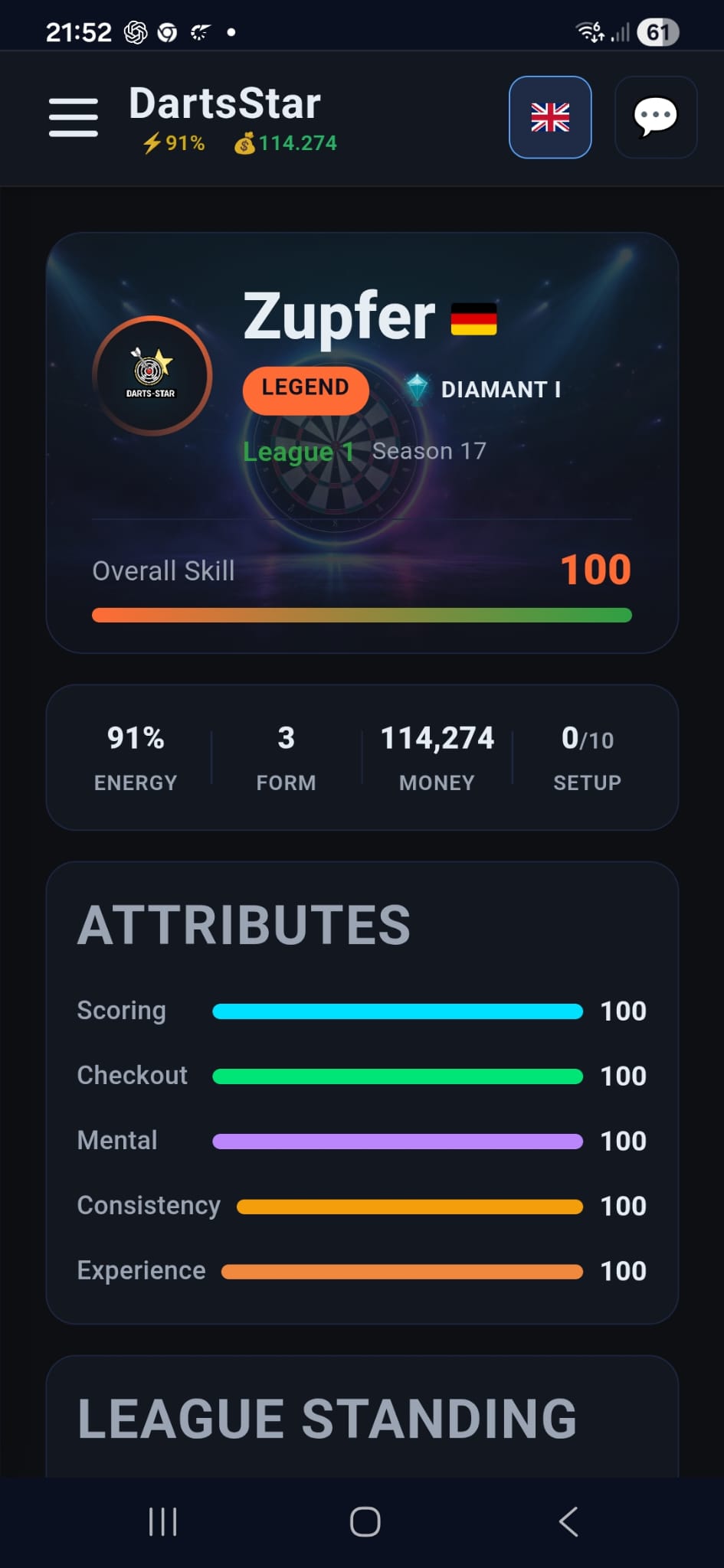
The training system is one of the most important parts of DartsStar. It develops several attributes that matter in different phases of a match – not just surface-level values, but stats that interact with the simulation engine in measurable ways.
Scoring determines how heavily your player scores during a visit and how consistently you reach high three-dart totals. High scoring helps you build pressure and close legs quickly.
Checkout is critical for finishing legs efficiently on doubles. Better checkout means fewer darts wasted at the end of legs, which directly translates to more wins in close matches.
Mental and consistency help absorb pressure situations. When the match is tight and the opponent is pushing, strong mental stats keep your performance from dropping under tension.
Technique and experience strengthen long-term development and stability. They improve over time through regular play and contribute to your player's overall ceiling.
The game also works with energy, daily form and fatigue. That means even the best drills are not always equally effective. You need to decide when to push hard and when to rest – the system rewards players who think ahead rather than blindly spamming training sessions.
The public game experience combines career overview, training decisions and long-term progression in one continuous interface.
How matches are simulated
DartsStar runs every match through a server-side simulation engine that uses your actual attribute values, current form, energy level, and opponent strength. This is not a simple random number generator – the simulation models real dart-by-dart play including scoring visits, checkout attempts, leg progression and momentum shifts.
Key factors that influence match outcomes:
Attribute balance: A player with high scoring but low checkout may dominate early legs but struggle to close tight ones. The simulation rewards well-rounded builds.
Form and fatigue: Daily form fluctuates and fatigue from consecutive training sessions reduces your effective stats. Planning your training around matchdays is essential.
Equipment and home advantage: Darts, shafts, flights and venue choice all feed into the simulation. Small percentage gains add up over a full season.
Match data transparency: After every match you get a detailed report showing your averages, checkout percentage, 180 count, leg scores and more. This lets you analyse exactly where you won or lost.
Understanding the simulation helps you make smarter training decisions. If your checkout rate is low, train checkout. If your scoring average trails behind the league, push scoring drills. The stats tell the story.
Economy and progression systems
Money in DartsStar is not just a side number. It flows through the whole career: you earn prize money from matches and tournaments, complete tasks for rewards, and invest in equipment, training boosts, and venue sessions. Every purchase is a strategic trade-off.
Equipment & shop
Buy and upgrade darts, shafts, flights and accessories. Better equipment gives small but meaningful stat bonuses. Equipment wears down over time and needs maintenance – neglecting it costs you performance.
Casino and betting
An optional casino system lets you place bets with in-game currency. It adds a risk/reward layer but is entirely optional – patient players can progress purely through match earnings.
Venue sessions
Spend time at venues for boosts to training efficiency, recovery speed or temporary stat bonuses. Venue management adds another planning dimension alongside training and matches.
Referral rewards
Invite friends and earn bonuses when they join and play. The referral system rewards community growth and gives both sides a head start.
Why league, cup and ranked matter together
The game depth becomes clear when the modes are viewed together. League, cup, ranked and long-term goals do not sit next to each other in isolation – they shape the same career loop. How you perform in the league influences your confidence going into a cup match. Ranked wins build momentum for the next league matchday. The systems are connected.
League
The league is the long-term backbone. It is not about a single match but about your whole season trajectory. Promotion races and relegation battles create narratives that play out over weeks and months.
Cup
Cup play adds knockout pressure and different stakes compared to league progression. One bad day ends your cup run. That creates a completely different emotional rhythm and forces you to prepare differently than for league matches.
Ranked
Ranked rewards active competition through visible MMR and placement movement. It is aimed at players who want real-time feedback on where they stand against the field. Ranked matches run on their own schedule so you can always find a game.
Return moments
Daily tasks, weekly goals, matchdays and training cycles create clear reasons to come back. The game is designed so that every login offers meaningful progress opportunities – you are never just waiting for the next matchday.
Frequently asked questions
Is DartsStar browser-only?
No. The browser version is the main access point, and there is also an Android app that wraps the same experience via Trusted Web Activity. Both versions share the same backend and progress, so you can switch seamlessly between phone and desktop.
Do I only play against bots?
No. Community features, rankings, league context and ranked revolve around real accounts. Match results are simulated on the server so the different systems stay consistent – but your opponents are real players with their own training, form, and progression.
Is the game designed for short or long-term play?
Clearly long-term. League seasons, cup tournaments, ranked seasons, training progression and career statistics are all built around ongoing development over many sessions. You build a career, not just a quick session.
Why is there a public guide?
So you can judge before signing up how league play, training and progression work. It helps visitors see whether DartsStar matches the kind of management game they want. We also offer a live preview page where you can see real league tables and community records without an account.
Is the game free to play?
Yes. DartsStar is free to play. All core systems – league, cup, ranked, training, equipment, venues – are accessible without payment. The game is supported by advertising, which helps us keep the servers running and the game in active development.
How often are matchdays?
Matchdays run on a regular schedule so you always know when to prepare. Between matchdays you train, manage your resources, play ranked matches and work on daily and weekly tasks. This creates a natural rhythm of preparation and competition.
Can I reset or restart my career?
DartsStar is designed as a persistent career. You can delete your account and start fresh if needed, but the game is built around long-term progression where early decisions shape your later options. There is no quick reset button per season – every season is part of one continuous career.
If you want more than the overview, there are now additional public pages covering training, competition structure and long-term progression. That gives visitors a much clearer picture before signing up.